Sunday, August 29, 2010

Coco Butter , Remove Dark Spot

my usual mustard on the current market situation 29.8.10

Hi, welcome
wiedermal to my Gloom & Doom Report.
The bearish chart of the week due to the Existing Home Sales. Better still, the stock turnover rate or its reciprocal, the Months Supply. Meaning, enough for as many months of inventory currently for sale pending, or how long a house is situated very close to camp. (Red line, right scale, inverted)
blue links, the development of house prices (annualized)

The sharp rise was not due to the stock, but by the collapse of demand. The latter is likely to continue though. The weekly Mortgage applications continue to show no recovery. Probably the most predictable consequence, there if the relationship between excess supply and prices will remain: a renewed violent collapse in house prices in the U.S..


Other story that haunts me straight through the head, is the quantitative easing program of the Fed. 've Written this several times.
Zb at 8.5:. http://franzlischka.blogspot.com/2010/05/mein-ublicher-senf-zur-aktuellen.html
5.4:. http://franzlischka.blogspot.com/2010/ 04/mein-ublicher-senf-zur-aktuellen.html
7.3. http://franzlischka.blogspot.com/2010/03/mein-ublicher-senf-zur-aktuellen.html (below)
Am 31.3. ended the program. In the last Fed meeting on 10 August was a momentous decision taken now. The stock of bonds in the balance sheet of the Fed should be kept constant. However: The MBS bonds that are repaid are now replaced by government bonds. The result is that the MBS spread, which was returned in June and July, in the expectation of a new QE program again is in accordance with this decision again increased significantly

Volatility (red: VIX) began after the Fed-meeting rising, falling stock prices.


The worst of the decline of risk capital, but once again caught the government bond the European periphery countries. The spread of Greece is in the 10-year sector almost back to where he stood at the height of the crisis in May, who is from Ireland, even on a new all-time high.

I have to say is not really clear to me why Bernanke made this decision, by which increased the risk premium, while the boom in U.S. government bonds was further fed on. If he wanted to keep the Fed's balance sheet more liquid bonds in order to shorten the event of a planned exit strategy for a resurgence of inflation faster the balance sheet, without him the consequences of the replacement of risky assets by (theoretically) "Riskless-assets" were aware of? Or it is becoming clear that the greatest danger is not a renewed recession, which in any event can hardly avoid, but a crash in the Treasury market? China, the largest investor in U.S. bonds has reduced its holdings in recent months. A day could have the consequences.

the end, however, a slightly more optimistic outlook in the short term. Although on 12 August triggered the so-called Hindenburg Omen and 20 August is confirmed. (Who has not heard of them, just googled times. The Webnachrichten are currently full of it.) The likelihood of a crash within the next 1 or 2 months has increased significantly. On the other hand, has just intensive reporting on the atmosphere can fall on such a negative level, that an immediate crash is unlikely. Difference of bulls minus bears in the AAII weekly sentiment survey of private investors from Thursday (Blue):

At this level, this is more of a clear bullish signal.
As negative for the markets in principle I am also short a clear short squeeze is conceivable, as he was on Friday to see even a small scale.
And so again until the next time.
Greetings
Franz

Sunday, August 15, 2010

Images Of Women Size 22

my usual mustard on the current market situation 15.8.10

Hello, register me back again. At least as long as the summer goes on, is my pleasure to write, but continue to remain low. Maybe I'll take me more time in the winter for the Tippselei.
order to my top issues in the financial markets recently.
Chart of the week (or even better the last 2 weeks) for me is the positioning of the U.S. dollar non-commercials (that most hedge funds), according to weekly figures from CFTC last Tuesday. (Contract number in the 8 most-traded currencies, left inverted scale, data from Bloomberg and CFTC, on Bloomberg under the ticker. IMM $ BETS to find G index).

In just two months the market from one extreme USD Bullishness to a historically rarely seen USD Bearishness is rotated. Reason is the weak U.S. economic data and the temporary calm in the euro crisis. My opinions as to the global economy, I have already often said. Mag apparently some consider to be nonsense, but if the United States falls into recession, I am convinced that the rest of the world will be chasing. The decoupling theories I've heard too often, was previously always wrong. I do not agree. If the U.S. falter in spite of extremely expansionary fiscal policy, all those countries that now tighten their belts, and there are many, not pride, especially in Europe, with strength. The good growth data in Europe in recent times, not least through the first euro weakness Half reasons. The euro zone currently can only survive with a weak euro, else everything falls apart here.
The charting now speaks more for a stronger USD.
AUD / USD: very nice, abiding by the outbreak of the bear wedge.


EUR / USD: The upward trend is over.


with the extreme short USD position of hedge funds, the USD recovery my view, to only just beginning. The often-heard opinion in mid-June, EUR / USD would again reach parity, but now I have long not heard it but now think even more realistic. As great as the problems in the U.S. may be, the de-leveraging is simply very USD bullish, because it leads to a reversal of the USD loans. The greater the crisis, the stronger the dollar, even if the crisis comes from the U.S.. Sounds strange, but Sun
For Risky assets would be USD strength, of course, fatal. The relationship is stronger than ever before: AUD / USD against MSCI World:

What is happening to? The bond markets are extremely strong, the fear of inflation deviates more and more afraid of deflation. This is evident not least because, when calculated as a magazine Focus Money that so far every other cover with his favorite topics of inflation and hyperinflation has gone, now suddenly warns of deflation (cover the week before last):


And because I'm in grad Covers: "The Shareholders' headline this week" starting gun to the rally. The cops are going on ". The mood coincides with the last two trading online reader survey:
http://www.boerse-online.de/vote/486517.html?todo=detail&voteid=614931
http://www.boerse-online. de/vote/486517.html? todo = detail & voteid = 614 663
No question, the mood, especially in Germany, is again clearly bullish. More
I do not tell time. Just this: The time from the last week of August to September historically is the worst by far time for stocks. Maybe not everything is as bad as I fear, but the next 1 ½ months, I'd rather wait and see either way. There's even a chart

economic cycle, before I let's be back. Again to my favorite recurring theme. Double-dip in the U.S. housing market. The recent Existing Home Sales were ok, but were still positively influenced by the tax credit. The Pending Home Sales were once again but where the direction goes: new all-time low. (Reminder: Pending Home Sales = signature, since May post-Tax Credit; Existing Home Sales = total settlement, usually 1-2 months later, but have Tax Credit recipients until late September time)

Initial Jobless Claims are by the way this week has risen to its highest level since February. Thus, my assumption proved true of 18.7. That led to the relaxation in early July only by a false seasonal adjustment.

So, fits better, despite the good mood, it could be dangerous. Let's see who laughs last. ;)

(Source Note: The funny at all, are they going on holiday, dedicated photo is from http://www.flickr.com/photos/egarc2/2437521787/ )

And so to Next time, if it pleased me again!
Greetings
Franz

Saturday, July 31, 2010

How To Delete Email Add From Facebook

my usual mustard on the current market situation 31.7.10

Hello,
yes, that was for me a surprisingly good month for equity markets, which is, come to an end, I must admit. He was certainly unusual, mainly because he did not fit into the typical on Risk (vs. Risk-off), and reflation (vs. deflation) trade scheme. The stock markets rose, but the same applies also to the world "safe" government bonds. be seen most clearly in the U.S., where the yield on the 5-year Treasuries (green, in%, left scale) on Friday since after the GDP figures at their lowest March 2009 were, who were the 2-year one week before ever fallen to an all-time low. Stock markets and bond yields, which are related since 1998 clearly positive, here last month went in different directions. While the bond markets have been moved by the most negative macro numbers, it was a positive season, which drove the stock markets.

In Europe, the situation was similar. While the Bund futures contract lost by a weakening of PIIGS crisis and after a very strong IFO figures (the latter I think, however, see Chart 3 July at the bottom, IFO to ISM,
http://franzlischka.blogspot.com/2010 / 07/mein-ublicher-senf-zur-aktuellen.html ., Usually for a trailer of the U.S. figures) If you look at in the inflation swaps (euro area) is priced in inflation, one sees a similar picture:

Also in the bond market moves more to the Deflation rail. The break-even rate in the 10-year sector (blue, in%, right scale) has fallen to a level that was achieved even in the financial crisis for a few days.
Who now has right to the stock or the bond market? Both? That would mean a return to the Goldilocks scenario of the 90s (high, but not to strong growth with falling inflation and increasing company profits). I can not imagine the best of intentions. I would be multiplied by the Bond Markets. The stock market has benefited from the quarterly earnings season, the first looks back (again 2nd quarter), and secondly has now passed its peak. In the future, so that the economic figures are not only on the bond, but also to the equity markets are important. The fact that S & P 500 and Euro Stoxx 50 are now both times failed in their 200-day lines, the level was also at the same time the previous motion from the June high, is there to mention also negative. Well, let's see. On Monday's is the ISM numbers already exciting.

more than a glance the current value of the commodity markets. While the chart provides the most economically principal raw material, crude oil, currently completely boring from. But otherwise does a lot. As would be one gold, the opposite of almost all assets currently has (but in line with falling inflation expectations in the bond market) breached its upward trend since 2008 to bottom has


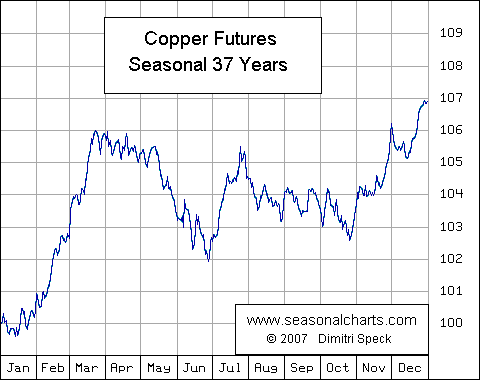
surprised me, however, the onset of the industrial metals, especially of copper on a near 3-month high. Not quite match the rather weak economic situation. Would interpret the time being but not too much into it. Copper is for any reason, in July, usually very strong:

The annual change in the copper price has thus also changed little. Moreover, the economy is lagging behind on occasion:

was watching the price of copper more times, but no big draw conclusions.

may be crucial is in the immediate future of the agricultural market. And since the less hyped in the media corner the cocoa market, where does in reality the last few weeks hardly anything. More important to the wheat market, exploding the moment after the catastrophic crop failures in Russia:

could well represent a significant development. Jim Rogers and Marc Faber have long been advised to purchase agricultural commodities, due to negative Roll-process yields is not a long-term investment. Could be, however, that many people now jump on the trade. This reminds me a little of the Spring 2008: An uncertain economic situation looks, too much cheap money, the non-cyclical returns, meets crop failures. Back then it was mostly rice and crop failures in Asia, this time just wheat and crop failures in Russia and Ukraine, but even before that in China. The outcome at the time: Exploding agricultural prices, especially rice and very serious unrest in many Asian countries. Do not know if it will be similar this time, but Jim Rogers and Co have been warning for more of a mismatch between supply and demand for food, and turn on rice, but this time it is (still) not affected by price increases.

Well, let's see. If at least one potential new flashpoint. I would guess that in the near future a lot of money will flow in agricultural commodity futures. If there is strong price increases, which would create inflation in the emerging markets, whose consumption basket is dominated much more by food to fuel than in Western countries, and attract a much tighter monetary policy by itself. That could stifle the emerging market boom again. No idea if it happens. Could I but imagine. 2008, we had just before such a similar situation. And so

until next time!
Greetings
Franz